Stop "RENTING" Conviction
"Why Following a Winning Option Trading Strategy Is a Financial Liability if You Have Not Personally Audited the Math."
Would you trade this strategy on "borrowed conviction"? 👉
The "Retail Cycle" in options Trading:
Break the "Borrowed Conviction" Loop
Are you on Google because your last strategy failed? Or perhaps it didn't fail. Perhaps you simply stopped trading it when the first 15% drawdown hit.
This is the cycle of the retail trader. You find a strategy. You “rent” conviction from a guru’s spreadsheet. You enter a trade. The market moves against you. You panic. You liquidate.
You didn’t fail because the strategy was flawed. You failed because you operated on “Borrowed Conviction.”
A strategy is only as strong as the data you used to falsify it. If you haven't personally stress-tested a setup you don't have an edge. You have a hope.
And hope is an expensive loan that the market calls in during every period of variance.
My “Second Job” Paid a Negative Hourly Rate
I am an engineer. In my professional career, I build complex systems. I am paid well for my precision.
But for years, I worked a second job. I traded options. In this job, I did not earn money. I paid for the privilege of working. My hourly rate was negative.
I followed established strategies. They sounded logical. They looked professional.
Reality was different. When a 15% drawdown hit, my logic disappeared. I felt the pressure. I liquidated the trades. I returned to Google to hunt for a “better” strategy.
Then I identified the fatal flaw. If you abandon every strategy at its lowest point, you stitch those losses together. You create a single, never-ending drawdown. You pay a massive price for a lesson you never finish.
I was ready to quit. I doubted the market. I realized I was merely a laborer in a negative-paying industry.
I shifted my focus. I stopped “renting” conviction from gurus. I turned my trading station into a stress-test laboratory. I used software to audit setups. I needed to see the math for myself.
I did not find a secret signal. I discovered "Owned Conviction". I found the mathematical proof required to trade through the variance.
Borrowed vs. Owned Conviction
Understand “Borrowed vs. Owned Conviction”
To understand why "Borrowed Conviction" is a financial liability, you must see how it breaks down in real-world market regimes.

Example 1 · The 20% Drawdown Wall
The 20% Drawdown Wall
You trade a Quant-style momentum strategy. The backtest looked great on a website. Then the market enters a choppy, sideways regime for three months. You hit a 20% drawdown. Because you didn't run the falsification yourself, you suspect the strategy is "broken" and you stop trading it.
Two weeks later, the market breaks out, and the strategy recovers all losses plus 30%. You watched from the sidelines because you lacked the data to know this drawdown was statistically normal.

Example 2 · The 95% Mirage
The Math of Ruin
You trade a high-probability "Income" strategy and sell deep Out-of-the-Money puts. The logic is seductive. The strategy boasts a 95% win rate. Every month you collect a small, consistent premium and treat the market like an ATM.
After 10 consecutive winners, your confidence shifts into certainty. You increase your contract size to accelerate your gains. By the time you reach 19 wins, you feel invincible and your equity curve never looked better.
Then the 20th trade arrives—the 5% statistical outlier. Because you are selling naked or wide-spread volatility, the loss is explosive. In a 48-hour window, a market gap turns your "safe" premium into a massive liability, erasing the last 19 wins and taking a chunk of your principal.
You didn’t fail because the strategy was broken. You failed because you never audited the Graveyard of Data to size for the inevitable. Without the Maximum Adverse Excursion data from 2008 or 2020, you rented a percentage from a guru instead of owning the math of the disaster.
Example 3 · The Earnings IV Trap
The Myth of the “Crush”
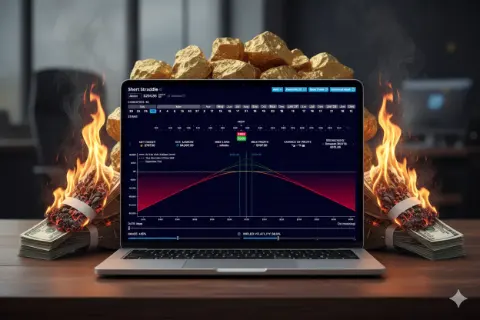
You follow the standard wisdom: sell high Implied Volatility before an earnings announcement. You see an IV Rank of 98% and hear the gurus promise the post-release "IV Crush." You sell a straddle and feel mathematically superior because you’re selling expensive premium.
The announcement drops. The IV collapses exactly as predicted, but the stock doesn’t stay inside the expected move. It gaps 15% on a 5% expectation. Delta and Gamma on your short options explode, and the volatility crush becomes a raindrop compared to the tidal wave of the price move.
High IV was high for a reason. Without auditing 21,500+ historical earnings events—including the graveyard data—you can’t tell the difference between a broken strategy and a statistically normal outlier. Without Owned Conviction, you abandon a potentially profitable system because you only rented a tactic.
From Hope to Falsification
From Hope to Falsification: How to Own the Math
You do not need a new strategy. You need a way to stop lying to yourself about the ones you already have.
In engineering, we don't "hope" a bridge stands. We find the failure point in a simulation so it doesn't fail in the real world. This is called Falsification.
I applied this same protocol to option trading. I stopped looking for "winners" and started looking for ways to prove my ideas wrong.
I built a laboratory—a software environment designed to strip away the "survivorship bias" and the "spreadsheet lies" of the guru world.

The Conviction Experiment
The Conviction Experiment: Can Mathematical Certainty Be Transferred?
I have a hypothesis. The difference between a trader who panics and one who profits is not "discipline." It is a structural lack of data. I want to test if I can transfer my conviction to you through raw, unredacted evidence.
I have identified a specific Delta 25 Long Call Strategy. I am not pitching a course. I am inviting you to participate in a 15-minute Laboratory Audit of this Strategy.
A standard long call with delta 25 loses money 75% of the time. I ran 289,000 trade occasions through my "Institutional Falsification Lab" to find the breaking point.
The Mystery Result · The Statistical EDGE
By applying three specific engineering filters, we strip away the hope and isolate the edge. After 7,000+ trades across every market regime since 2007, the math is undeniable:
Start the Lab Audit
Quantify Your Options. Own Your Conviction.
Enter your details to access the 15-minute audit video and see if "Conviction" is transferable?
You’ll receive the 15 minute Video and some additional emails. Unsubscribe anytime. No spam. Only unredacted data.
Your Role in the Experiment
- Watch the Video: See how the Quant-Audit Engine falsifies the setup in real-time.
- Complete the Survey: After reviewing the unredacted data, tell me if conviction feels transferable.
The information provided on QuantifyOptions.com is for educational and illustrative purposes only and should not be considered financial, investment, or trading advice. Options trading involves significant risk and is not suitable for every investor; you are solely responsible for your own decisions and should consult a licensed financial professional before acting on any information presented.